
Short answer
SE Ranking is the best rank tracker for most people because it checks 2,000 keywords a day for $129/mo and throws in keyword research, audits and backlinks. Nightwatch is the strongest standalone tracker for teams, with unlimited seats. AccuRanker suits big agencies that care about speed more than price.
Top picks
Prices checked October 2026
- Best overall
SE Ranking
Best overall: tracking plus a full SEO suite
Starts at $129/mo ($103.20 annually)
Try free for 14 days - Best for teams
Nightwatch
Teams, local and AI tracking in one place
Starts at €79/mo
Nightwatch pricing - Best at scale
AccuRanker
Large agencies tracking at scale
Starts at $224/mo for 2,000 keywords
AccuRanker pricing
On this page
- Rank trackers: comparison table
- What 1,000 daily keywords really cost
- SE Ranking
- Nightwatch
- AccuRanker
- Wincher
- Semrush Position Tracking
- Ahrefs Rank Tracker
- Mangools SERPWatcher
- Google Search Console
- How to choose a rank tracker
- Daily vs weekly tracking
- Local and mobile tracking
- How we compared these rank trackers
- FAQ
- The bottom line
Rank trackers compared
Prices below are monthly list prices from each vendor's pricing page, checked in October 2026. Some vendors bill in euros.
| Tool | Entry price | Keywords at entry | Update frequency | Sites at entry | Trial | Link |
|---|---|---|---|---|---|---|
| Our pickSE Ranking | $129 ($103.20 annual) | 2,000 | Daily | 10 projects | 14 days, no card | Try SE Ranking |
| Nightwatch | €79 | 500 | Daily | 5 | 14 days, no card | Nightwatch |
| Wincher | €49 | 500 | Daily | Up to 10 | Free trial | Wincher |
| AccuRanker | $224 | 2,000 | Daily | Plan-based | See vendor | AccuRanker |
| Semrush | $139 ($117.33 annual) | 500 | Daily | 5 | 7 days | Semrush |
| Ahrefs | $129 (Lite) | 750 | Plan-based | 5 non-verified | None | Ahrefs |
| Mangools | $37.70 annual | 200 | Weekly (daily on Agency) | Unlimited domains | 48h money-back | Mangools |
| Search Console | Free | Your own queries | Daily data, average position | Your own sites | Free | Search Console |
What 1,000 daily keywords really cost
Entry prices hide a lot. This is the monthly list price divided by the number of daily tracked keywords at entry level, scaled to 1,000:
- SE Ranking Core: about $65 per 1,000 keywords ($129 for 2,000)
- Nightwatch Professional: about €64 per 1,000 (€159 for 2,500)
- Wincher Standard: about €89 per 1,000 (€89 for 1,000)
- AccuRanker Professional: about $112 per 1,000 ($224 for 2,000)
- Nightwatch Starter: about €158 per 1,000 (€79 for 500)
- Semrush SEO: about $278 per 1,000 ($139 for 500)
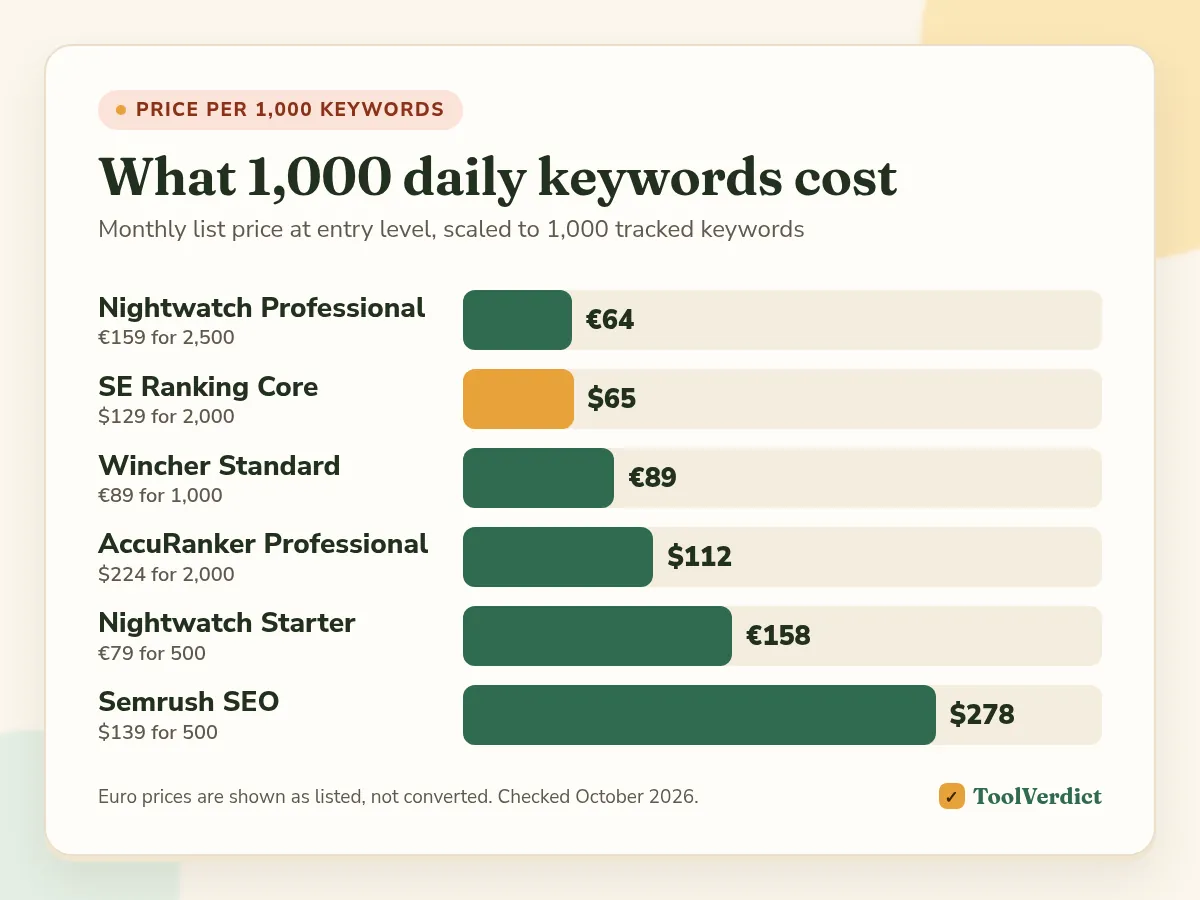
Only SE Ranking and Semrush include a full keyword research and backlink toolset in that price. Nightwatch and Wincher include lighter research tools. So the cheapest tracker per keyword isn't always the cheapest setup overall.
SE Ranking: best rank tracker for most people
SE Ranking started life as a rank tracker and that's still its best feature. It now sits inside a full SEO suite, so you get research, audits and backlinks without a second subscription.
The SE Ranking pricing page lists Core at $129/mo ($103.20 annually) with 2,000 keywords checked daily, 10 projects, unlimited keyword, competitor and backlink research and 250,000 audited pages a month. Growth ($279/mo, $223.20 annually) raises that to 5,000 keywords, 30 projects and 3 seats. You can track by country, city or ZIP code on desktop and mobile, follow competitors and SERP features, and send scheduled reports. Core also includes 25 AI prompts a day across 5 AI engines.
Full details in our SE Ranking review.
Pros
- 2,000 daily keywords at entry, the most room per dollar among the suites here
- Full SEO toolkit included, not just tracking
- Local tracking down to ZIP code level
- 14-day trial with no card
Cons
- One manager seat on Core
- Payments are non-refundable unless the service wasn't delivered
- Smaller keyword database than Semrush or Ahrefs for research
Nightwatch: best standalone tracker for teams
Nightwatch is a dedicated rank tracker that has grown into an "SEO plus AI visibility" platform. Its big selling point is that every plan includes unlimited seats.
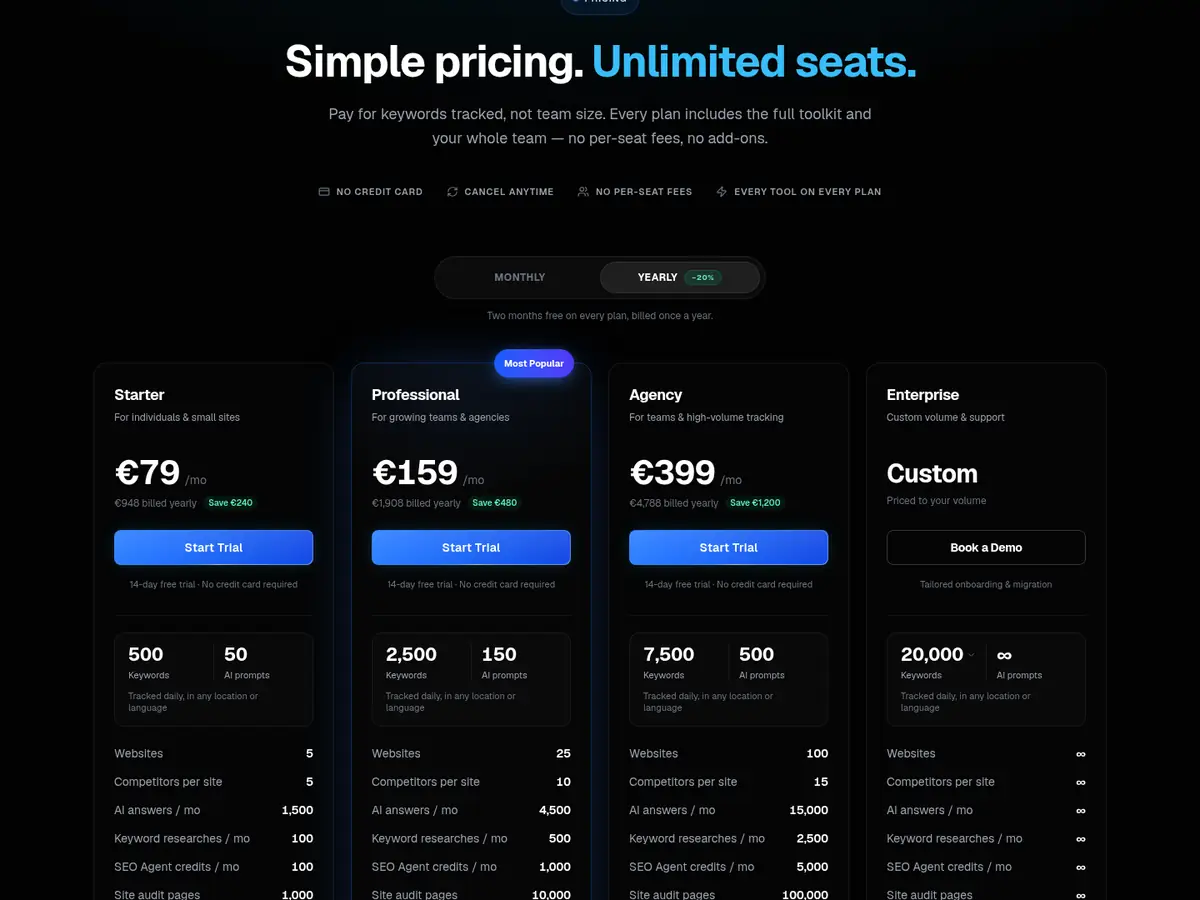
On the Nightwatch pricing page Starter costs €79/mo for 500 keywords tracked daily on 5 websites, 50 AI prompts and 1,500 AI answers a month. Professional is €159/mo with 2,500 keywords, 25 sites and 150 prompts. Agency is €399/mo with 7,500 keywords, 100 sites and white-label reports. It tracks Google, YouTube, Bing, Yahoo, DuckDuckGo and Google Maps across 107,000+ locations and keeps 3 years of SERP history. AI tracking covers ChatGPT, Claude, Gemini, Perplexity, AI Mode and AI Overviews. The trial lasts 14 days, needs no card and pauses tracking at the end rather than charging you.
Pros
- Unlimited team seats on every plan
- Broad engine and location coverage, including Google Maps
- AI visibility built in, with six AI platforms
- Honest trial: no card, no surprise charge
Cons
- Starter is pricey per keyword; Professional is where the value is
- Looker Studio, API and white label start on Professional or Agency
- Lighter research tools than a full suite
AccuRanker: best for large agencies
AccuRanker is the tracker many big agencies use when they need fast, frequent updates on huge keyword sets. It's not cheap, and it doesn't try to be.
The AccuRanker pricing page shows Professional at $224/mo for 2,000 keywords with daily updates, keyword research, search intent, tagging, filtering, GSC and GA integration and exports. Expert starts at $764/mo for 10,000 keywords and adds dynamic tagging, AI CTR, its own search volume data, Looker Studio and an unlimited read API. Enterprise covers more than 25,000 keywords. Annual billing saves 10%, and you can change or cancel the plan at no cost.
Pros
- Built for scale, with strong tagging and filtering
- Flexible keyword tiers on each plan
- Cancel or change plans without fees
Cons
- Expensive for small sites
- Tracking-focused; you'll still need a research tool
- API and Looker Studio only on Expert
Wincher: best budget dedicated tracker
Wincher is a Swedish rank tracker with a clean interface and fair entry prices. It's a good fit if you want daily tracking and don't need a full suite.
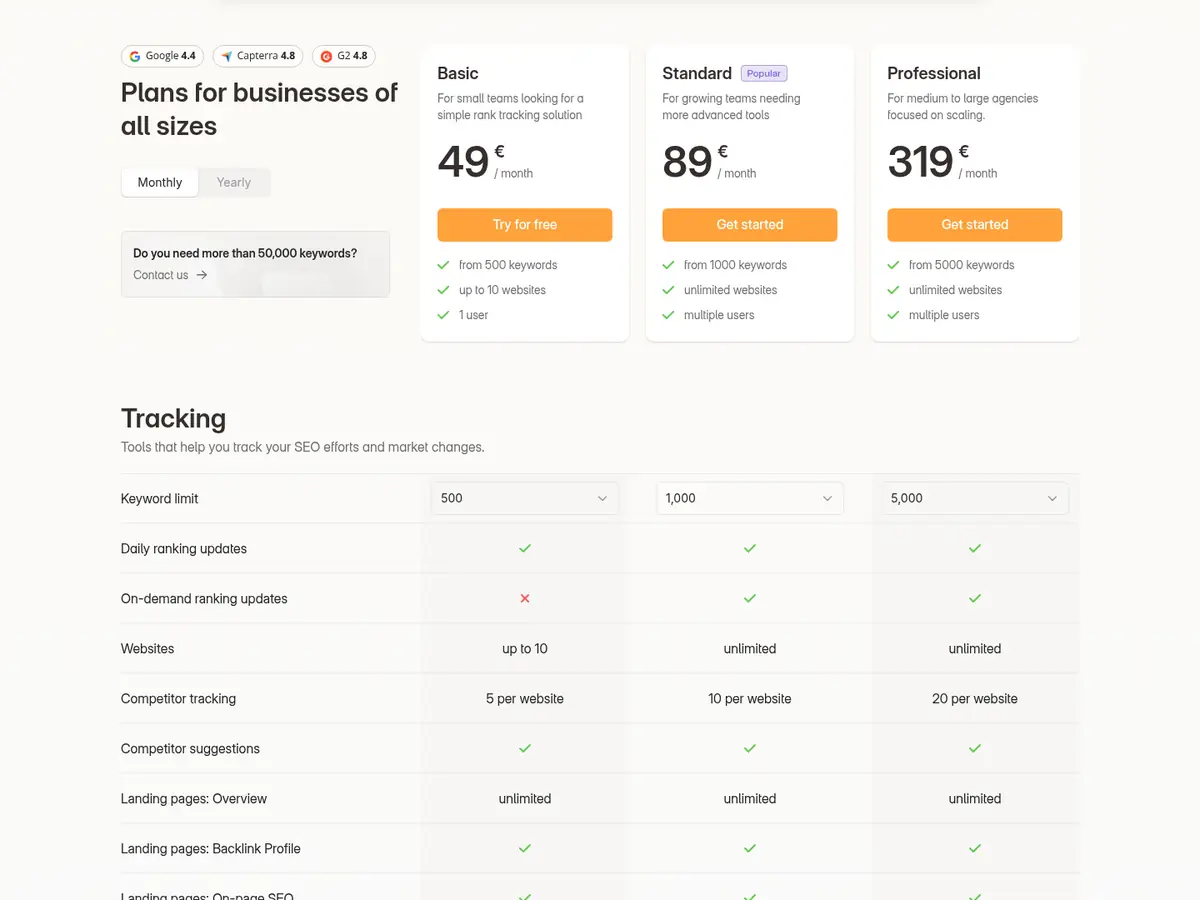
The Wincher pricing page lists Basic at €49/mo for 500 keywords, up to 10 websites and 1 user. Standard is €89/mo from 1,000 keywords with unlimited websites and multiple users. Professional is €319/mo from 5,000 keywords. All plans include daily updates, competitor tracking (5 per site on Basic), a Keyword Explorer with unlimited daily lookups, an on-page SEO checker and PDF reports. Google Maps tracking runs on credits, with 25 included and extras at €10 per 500. White-label reports, Looker Studio and API come on higher tiers.
Check the monthly and yearly toggle on the pricing page before you buy.
Pros
- Low entry price for daily tracking
- Unlimited keyword explorer lookups
- Simple, friendly interface
Cons
- One user on Basic
- No white label on Basic
- Lighter backlink and audit features than a suite
Semrush Position Tracking: best if you already use Semrush
If you're paying for Semrush anyway, Position Tracking is good and well integrated. It's just an expensive way to buy a rank tracker.
The Semrush pricing page gives 500 tracked keywords a day on the $139 SEO plan ($117.33 annually) and on the $199 Starter plan, 1,500 on Pro+ ($299) and 5,000+ on Advanced. Multi-location and device tracking come with Pro+. Extra users cost from $45/mo.
Comparing the big suites? See Semrush vs Ahrefs.
Pros
- Strong integration with Semrush's research tools
- Multi-location and device tracking on Pro+
- 7-day trial
Cons
- Only 500 keywords at entry
- Expensive per keyword
- Extra users add up
Ahrefs Rank Tracker: best for Ahrefs users
Ahrefs Rank Tracker is clean and easy to read, and it ties into Site Explorer and Keywords Explorer. Like Semrush's, it's part of a bigger bill.
According to the Ahrefs pricing page, Lite ($129/mo) includes 750 tracked keywords, Standard ($249) 2,000 and Advanced ($449) 5,000. There's no free trial, and refunds are generally not offered.
Pros
- Good visuals and SERP history
- Tight link with Ahrefs research tools
Cons
- Fewer keywords per dollar than dedicated trackers
- No trial, generally no refunds
Mangools SERPWatcher: best for bloggers
SERPWatcher is the rank tracker inside Mangools. It's simple and cheap, and it updates weekly on the lower plans.
The Mangools pricing page shows Basic at $37.70/mo billed annually with 200 tracked keywords on unlimited domains, updated weekly. Premium ($52.70 annually) raises that to 700. Daily updates come only on the Agency plan. You also get KWFinder and the other Mangools apps.
Pros
- Very cheap with a full keyword research toolkit
- Easy for beginners
- 48-hour money-back guarantee
Cons
- Weekly updates below Agency
- Low keyword counts
Google Search Console: the free option
Search Console isn't a rank tracker in the strict sense, but it's free and every site owner should use it.
It shows the queries your site appears for, clicks, impressions and average position over time. It doesn't show competitors, exact daily positions in one city, or keywords you don't rank for yet. Use it alongside a tracker, not instead of one, once you have clients or money on the line.
Pros
- Free, data straight from Google
- Shows queries you didn't know you ranked for
Cons
- Average position only
- No competitor tracking or local grid
How to choose a rank tracker
- Count your keywords. Multiply sites by keywords per site, then add 20% for growth. That number picks your plan more than any feature list.
- Decide on daily or weekly. Client work and competitive niches need daily. A personal blog can live with weekly.
- Check local needs. If you serve a city, you need city or ZIP level tracking, and maybe Google Maps.
- Count users. Nightwatch has unlimited seats; most others charge per seat or cap users.
- Think about reports. Agencies need white label and scheduled reports. Check which plan unlocks them.
- Decide on AI tracking. If AI Overviews and ChatGPT answers matter to you, pick a tool that tracks prompts, or add a dedicated tool from our AI visibility tools guide.
Daily vs weekly tracking
Daily tracking costs more, but it pays off when something breaks. If rankings drop on Tuesday, you want to know on Wednesday, not next Monday. Daily data also makes Google updates easier to spot and explain to clients.
Weekly tracking is fine when you're watching long-term trends on a stable site. Many bloggers start on weekly with Mangools and move to a daily tracker once the site earns money. For more budget picks, see our cheap SEO tools guide.
Local and mobile tracking
Google results change by city and device. A plumber in Leeds and one in London see different results for the same search. If you do local SEO:
- track at city or ZIP level, not only country
- track mobile separately from desktop
- add Google Maps tracking if you rely on the local pack
SE Ranking, Nightwatch and Wincher all cover local tracking. Nightwatch has the widest location list (107,000+), and Wincher charges Maps checks as credits.
How we compared these rank trackers
In October 2026 we opened each vendor's official pricing page and recorded the entry price, keyword limits, update frequency, number of sites, users, trials and refund or cancellation terms. Where prices loaded with JavaScript, we rendered the page fully before reading the numbers. We then worked out the cost per 1,000 daily keywords so plans with different sizes could be compared fairly.
We did not run a controlled accuracy test across these trackers, so we don't rank them on accuracy and we don't quote accuracy percentages. Vendor claims are labelled as such.
We earn a commission from SE Ranking and Mangools links. Nightwatch, Wincher, AccuRanker, Semrush and Ahrefs links are plain links. See our affiliate disclosure.
Frequently asked questions
What is the best rank tracker?
For most people it's SE Ranking: 2,000 keywords checked daily across 10 projects for $129/mo ($103.20 annually), with keyword research and audits included. Nightwatch is the best pure tracker for teams, and AccuRanker suits agencies that need speed at scale.
What is the cheapest rank tracker?
Google Search Console is free but shows average positions, not daily ranks. Among paid tools, Wincher starts at €49/mo for 500 keywords and Mangools Basic at $37.70/mo billed annually for 200 keywords updated weekly.
Which rank tracker is the most accurate?
All the trackers here check live Google results, and none publishes an independent accuracy audit. Differences usually come from location, device and timing settings, so set those to match your real audience.
How often should I check keyword rankings?
Daily for client sites, competitive keywords and after big changes. Weekly is fine for blogs and stable sites. Daily data also makes it easier to spot Google updates.
Can I track local rankings and Google Maps?
Yes. SE Ranking tracks by city or ZIP code, Nightwatch covers Google Maps and 107,000+ locations, and Wincher includes Google Maps tracking with credits.
Do rank trackers show AI Overviews and ChatGPT results?
Many now do. SE Ranking Core includes 25 AI prompts a day, Nightwatch includes 50 prompts on Starter across ChatGPT, Claude, Gemini, Perplexity and Google's AI features, and Semrush adds prompt tracking from its $199 tier.
The bottom line
If you want one tool that tracks lots of keywords daily and also handles research and audits, go with SE Ranking. If you want a standalone tracker your whole team can log into, try Nightwatch. Big agency with a big keyword list? Look at AccuRanker. And whatever you pick, keep Search Console running next to it.